

One of the most common questions nonprofit executive directors ask when applying for a line of credit is a deceptively simple one: how large should it be?
After reviewing nonprofit line of credit applications since 2012, I can tell you the amount an executive director requests is often very different from the amount that makes financial sense for the organization. As a general guideline, we approve nonprofit lines of credit at roughly 3% to 5% of annual revenue. That figure surprises most people who apply, because they arrived at their number a completely different way.
At Financing Solutions, we specialize in lines of credit for small nonprofits, typically organizations with annual revenue between $400,000 and $5 million. I personally review many of the applications that come through our company, and I usually speak with the executive director who submitted one. The question I almost always ask is how they arrived at the amount they are requesting. The answer tells me a great deal about how the organization thinks about its cash flow.
Why nonprofits usually ask for too much
Executive directors nearly always have a logical reason for the number they choose. A typical explanation sounds like this: “We have a $300,000 government reimbursement coming, and if it’s delayed 60 days we need enough to cover two months of payroll.”
The reasoning makes sense. The problem is that it calculates the organization’s potential cash need rather than its ability to repay. Those are very different things.
Take a nonprofit with $750,000 in annual revenue applying for a $350,000 line of credit. The thinking goes: we have $750,000 coming in each year, so if we borrow $350,000 we’ll repay it when the grant or reimbursement arrives. But a responsible lender has to ask a harder question. Can this organization realistically afford to repay $350,000, plus the cost of borrowing it, on the cash flow it actually has? For many small nonprofits, the honest answer is no.
Revenue alone doesn’t determine the amount
One of the biggest mistakes I see is the assumption that annual revenue sets the borrowing limit. Revenue matters, but it is one input among several.
Nonprofits usually operate on very tight margins. Most of the money coming in is already committed to payroll, programs, rent, insurance and vendors. A nonprofit generating $750,000 in revenue does not have hundreds of thousands of dollars of spare cash sitting available to service debt. A lender also has to weigh existing debt, the consistency of cash flow, demonstrated repayment ability and, depending on the lender, collateral.
That is why an ethical lender shouldn’t simply approve the largest line an organization requests. The goal is an amount the nonprofit can manage without putting itself at risk.
How much can a nonprofit typically get?
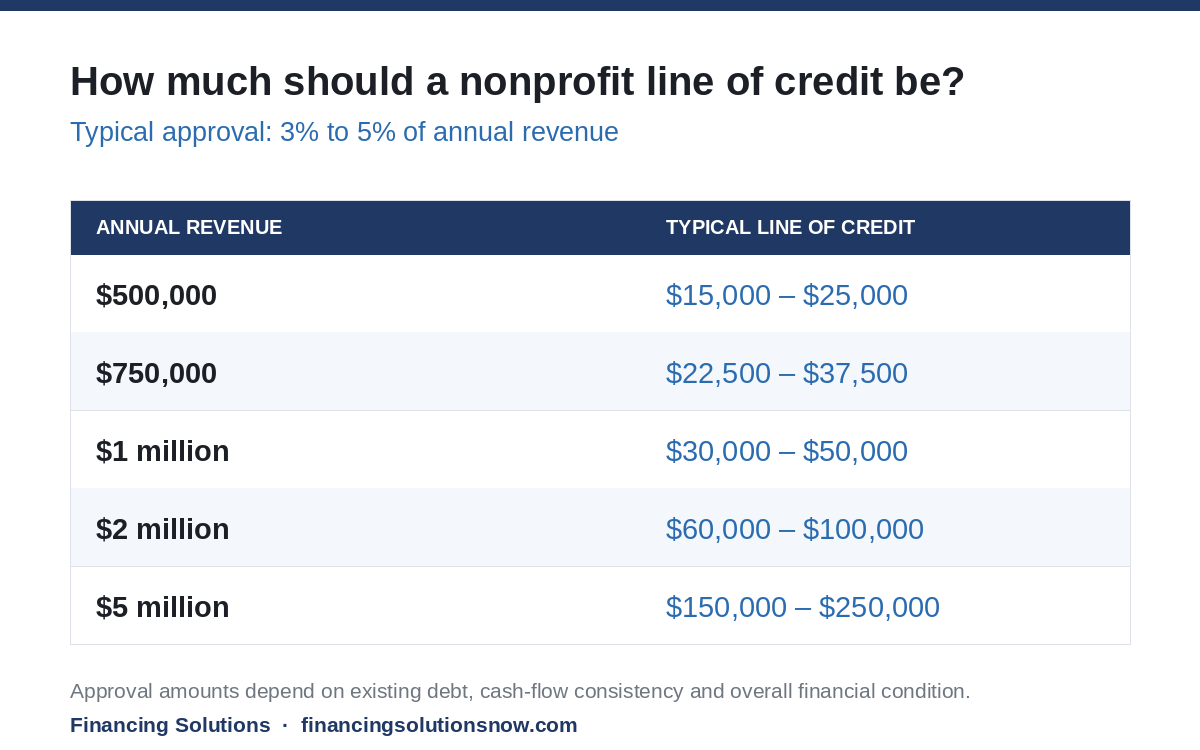
At Financing Solutions, approvals generally land around 3% to 5% of annual revenue. A nonprofit with $1 million in revenue is usually looking at a line somewhere in the $30,000 to $50,000 range, depending on its overall financial condition.
Not every organization qualifies for that. Existing loans and credit card balances reduce the amount a nonprofit qualifies for, and in some cases prevent qualification altogether.
Consistency of incoming cash matters just as much. If your organization regularly goes through long stretches with little coming in, that weighs heavily. A line of credit requires payments while a balance is outstanding, so the nonprofit needs enough ongoing cash flow to service the debt while it waits for the grant, reimbursement or donation it is counting on.
What you need and what you can afford are different numbers
This is the single most important point for an executive director to understand.
You may calculate that your organization could face a $200,000 cash-flow gap. That does not mean you should have a $200,000 line of credit. The question to ask is whether you could comfortably repay the full amount if you drew all of it. That is exactly the question the lender is asking.
In nearly every conversation I have on this subject, the executive director understands the distinction once we walk through it. They may have applied for a much larger amount, but after reviewing revenue, existing debt, cash flow and repayment ability, they can see why a smaller line is the healthier outcome for their organization.
Your line can grow over time
Starting smaller is not a disadvantage. We prefer to build a relationship with a nonprofit before substantially increasing its available credit, because we want to see how the organization uses the line. Does it make its payments? Does it borrow for genuinely short-term needs? Does it pay the balance down when the expected funding lands?
As a nonprofit builds that history, there are usually opportunities to increase the size of the line. From where I sit, that is a far healthier path than handing an organization more credit than it can carry on day one.
A line of credit is short-term financing
A line of credit is designed to solve short-term cash-flow problems. Think weeks or a few months, not years.
A typical case: a state reimbursement expected June 1 doesn’t arrive until July 15, and payroll still has to be met in June. The organization draws what it needs, keeps operating, and repays the line when the money arrives. That is exactly what the product is for.
What concerns me is a nonprofit that draws its line and never brings the balance back to zero. If your organization has carried a balance for a year or more and cannot pay it down, you probably don’t have a temporary cash-flow problem. You may have an expense problem.
Don’t use credit to postpone hard decisions
This is particularly difficult for nonprofits, where payroll is often the largest expense. Reducing staff is painful. Nonprofit employees tend to be deeply committed to the mission, they can feel like family, and no executive director wants to let good people go.
But the organization’s first obligation is to remain financially sustainable. A nonprofit that ceases to exist cannot serve anyone. A line of credit can bridge a temporary gap; it should not be used indefinitely to defer necessary changes. If the balance never comes down, address the underlying problem sooner rather than later.
Where can a nonprofit get a line of credit?
Small nonprofits have fewer financing options than for-profit businesses. There are three broad categories worth understanding.
Traditional and local banks
A commercial or local bank may offer nonprofit financing, though small nonprofits often find bank underwriting difficult. Depending on the institution, a bank may require collateral, guarantees, extensive documentation or a lengthy underwriting process. Organizations with substantial assets and long financial histories tend to have more options here.
Alternative nonprofit lenders
Financing Solutions is a direct alternative lender specializing in unsecured lines of credit for small nonprofits. Because we use investor capital rather than bank deposits, we set our own underwriting guidelines. Our line requires no collateral and no personal guarantee except in cases of fraud, and there is no cost to establish or maintain it when it isn’t drawn.
Cash advance companies
Be careful comparing a true line of credit against products marketed as fast business funding or cash advances. A cash advance is not a revolving line of credit. These products can carry very high financing costs and often require frequent repayments over a short period, and in some arrangements paying early does not reduce the total cost the way an executive director might expect.
Before accepting any offer, make sure you understand the total repayment amount, the payment frequency, the effective cost of the financing, and whether early repayment saves you anything. Don’t choose a financing product based on how quickly someone will hand you money.
Five questions to size your line
There is no single right number for every organization, but five questions get you close:
- What is our annual revenue?
- How much debt does the organization already carry?
- How consistent is our monthly cash flow?
- How long will we realistically need the borrowed funds?
- If we drew the entire line, could we comfortably repay it when our expected funding arrives?
The last one matters most. Don’t ask what the most money you could possibly need is. Ask what amount of short-term credit your organization can safely use and repay.
The bottom line
After years of reviewing these applications, I see the same mistake repeatedly: an executive director calculates the worst-case cash-flow shortage and assumes the credit line should match it. It shouldn’t.
A nonprofit line of credit should be large enough to bridge a realistic short-term gap and small enough that the organization can comfortably repay it. For many small nonprofits, 3% to 5% of annual revenue is a sensible starting point, with debt, cash flow and overall financial condition determining the final approval.
The goal isn’t to borrow as much as possible. It’s to have the right amount available when your nonprofit needs it, and to know you can pay it back.
Financing Solutions has specialized in helping nonprofits obtain lines of credit since 2012. Our nonprofit lines of credit require no collateral or personal guarantee except in cases of fraud, and there is no cost to establish or maintain the line when it isn’t being used. Financing Solutions holds an A+ rating from the Better Business Bureau and a 5.0 rating from 40 Google reviews.
We also provide lines of credit for churches, private and charter schools, and small businesses.
Frequently asked questions
How much should a nonprofit line of credit be?
There is no universal amount. At Financing Solutions, nonprofit lines of credit are typically approved at approximately 3% to 5% of annual revenue, subject to the organization’s debt, cash flow and overall financial condition.
What can a nonprofit use a line of credit for?
A line of credit is best suited to temporary cash-flow needs: delayed grants, government reimbursements, seasonal donation cycles, payroll timing differences and unexpected short-term operating expenses.
Should a nonprofit carry a line of credit balance for a year?
Generally no. A line of credit suits short-term gaps. If an organization continuously carries a balance it cannot pay down, leadership should determine whether the real issue is a structural budget or expense problem rather than a timing problem.
Can a nonprofit get an unsecured line of credit?
Yes. Financing Solutions provides unsecured lines of credit to qualifying nonprofits without collateral or personal guarantees, except in cases involving fraud.
Does a nonprofit pay for a line of credit it doesn’t use?
That depends on the lender. Financing Solutions charges no setup or annual maintenance fee for its nonprofit line of credit. Costs apply only when funds are drawn.