

Every nonprofit that applies to us for a line of credit answers one question before anything else: how do you plan on using it? There are eight options and applicants can check as many as apply. Nobody writes an essay. They just tell us, in a few clicks, what they are worried about.
We went back and looked at every answer we have collected since 2019 — 6,555 completed responses out of 8,034 applications. What they show is not a snapshot. It is a shift. The reasons nonprofits give for wanting access to credit have changed substantially in the last three years, and they have changed in one direction.
Methodology: This analysis is based on 8,034 line of credit applications submitted to Financing Solutions between January 2019 and October 9, 2026. Of those, 6,555 (81.6%) included a completed response to the question “How do you plan on using your Line of Credit?” Applicants select from eight fixed options and may choose more than one, so percentages total more than 100%. The eight options and their wording have not changed since the question was introduced. 2019 is excluded from year-over-year comparisons because it contains only 175 completed responses. Findings describe organizations that applied to Financing Solutions and are not a representative sample of all U.S. nonprofits.
- The share of applicants citing delayed payments rose from 36.2% in 2023 to 51.2% in 2026 — the first time it has been a majority
- Applicants citing payroll rose from 31.0% to 41.1% over the same period
- Applicants seeking credit for new opportunities fell from 51.8% to 39.4%
- 22.3% of all respondents selected both delayed cash flow and avoiding a missed payroll — the two concerns arrive together
- The single most-selected reason overall is starting programs when funding is already committed but has not yet arrived (48.2%), which is a timing problem rather than an emergency
Summary
Why Nonprofits Say They Need a Line of Credit
Across all 6,555 completed responses, here is how often each option was selected:
- 48.2% — Start programs when we know funding is coming (3,162 applications)
- 47.6% — For new opportunities (3,118)
- 39.8% — Even out uneven cash flow when payments delayed (2,611)
- 33.8% — Make sure we don’t miss payroll (2,217)
- 26.8% — Not have to ask others for emergency loan (1,757)
- 25.7% — Just as an emergency backup plan (1,683)
- 25.2% — Avoid having to lay off staff or stop services (1,649)
- 13.9% — Use for 3 payroll months (912)
The average applicant selects 2.6 reasons. Very few organizations come to us with a single concern.
One note on how to read this list, because it is the first thing a careful reader should ask about any checkbox survey. Options that appear near the top of a list usually get selected more often simply because they are read first. That did not happen here. The option listed first on our form ranks third in selections. The option listed last ranks second. The option listed third ranks seventh. Whatever is driving these answers, it is not the order of the boxes.
The Most Common Reason Isn’t an Emergency. It’s Timing.
The single most-selected option is “start programs when we know funding is coming.” It is worth sitting with that wording for a moment, because it is easy to misread as optimism.
It is not a nonprofit gambling on growth. It is a nonprofit that has already been awarded the money, has already been told the program is funded, and is waiting for the check to clear a process it does not control. The grant is real. The timing is the problem.
Read that way, the top of the list looks different. Nearly half of applicants (48.2%) want credit to bridge against funding that has been committed but not delivered. Another 39.8% want it to bridge against payments that are simply late. These are not two different problems. They are the same problem pointed in two directions — money that exists on paper and does not exist in the bank account yet.
Delayed Payments Have Become the Defining Issue
Between 2020 and 2023, the share of applicants citing delayed payments sat in a narrow band between 32% and 36%. It has not stayed there.
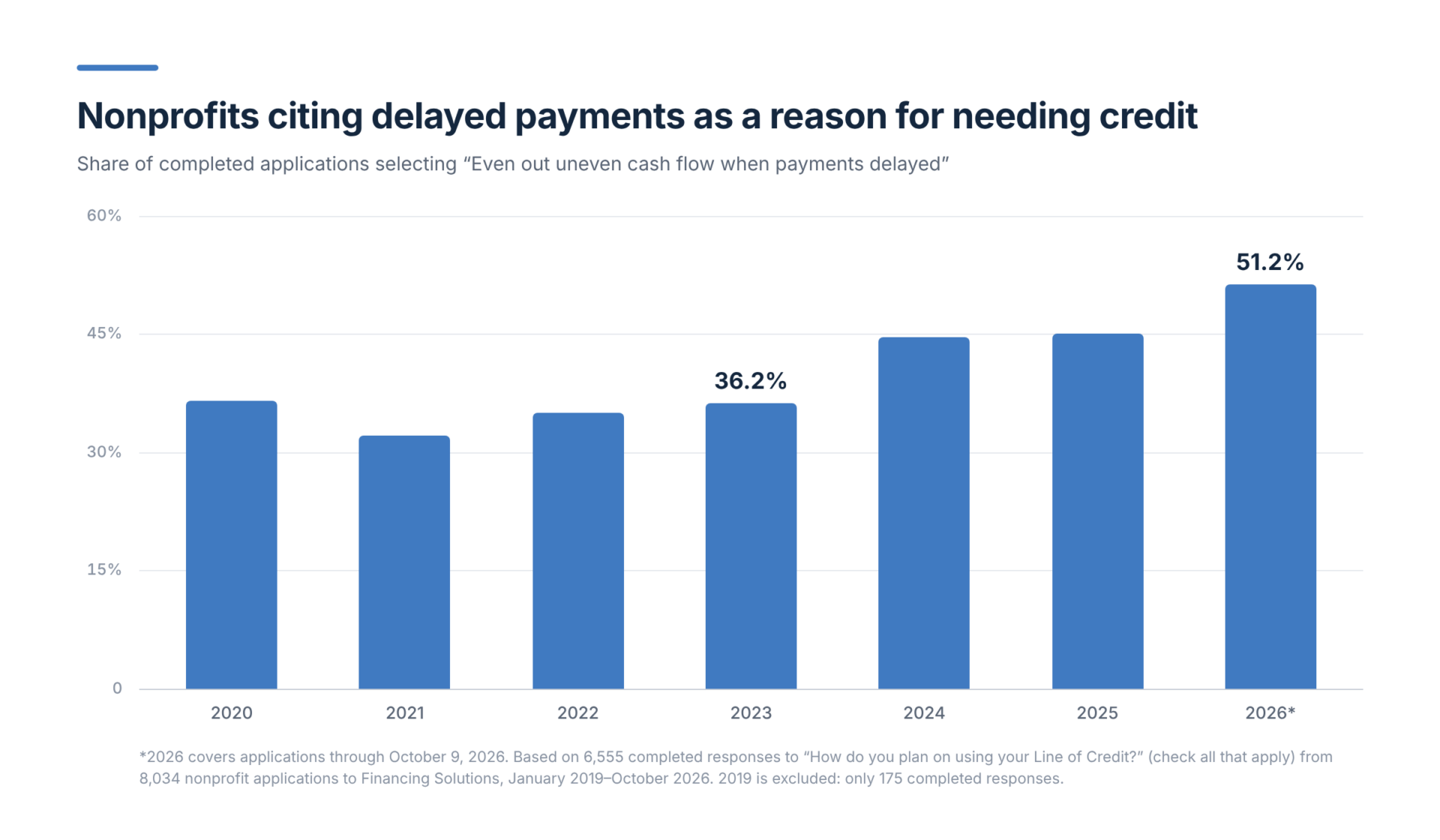
From 2023 to 2026, that figure climbed from 36.2% to 51.2%.
For the first time in the period we can measure, a majority of nonprofits applying for a line of credit say they need it because money they are owed is not arriving on time.
This lines up with what we described in our analysis of how nonprofits are responding to federal funding uncertainty, where we found organizations becoming markedly more conservative since 2025. The application data shows the same thing from the other side of the desk. Nonprofits are not reporting that funding has disappeared. They are reporting that it has become slower and less predictable.
Payroll and Cash Flow Are the Same Conversation
33.8% of all applicants select “make sure we don’t miss payroll.” Since 2023 that figure has risen from 31.0% to 41.1%.
The more telling number is the overlap. 22.3% of all respondents — 1,465 organizations — selected both delayed cash flow and avoiding a missed payroll. Nearly one in four applicants is telling us these two things in the same breath.
That overlap is the whole story of nonprofit cash flow in one statistic. A delayed reimbursement is an accounting inconvenience right up until the moment it collides with a payroll date, and then it becomes a decision about people. Another 25.2% of applicants select “avoid having to lay off staff or stop services,” which is what that decision looks like when there is no credit line to absorb it.
For most nonprofits payroll is the largest and least flexible expense on the books. A business can usually stretch a vendor. No organization can stretch a paycheck.
What Is Falling: Borrowing for Growth
While cash-flow concerns have risen, the opposite has happened to growth.
In 2023, 51.8% of applicants selected “for new opportunities.” By 2026 that had fallen to 39.4% — a drop of more than twelve points in three years.
Pooled across the whole period, growth still looks healthy: 47.6% of all applicants have selected it, making it the second most common answer overall. But the pooled figure is an average of a period that no longer resembles itself. The direction of travel is unmistakable. Organizations that would once have borrowed to expand are now borrowing to hold steady.
There is one encouraging counterpoint. 25.9% of applicants — 1,695 organizations — selected both “start programs when we know funding is coming” and “for new opportunities.” More than a quarter of nonprofits seeking credit are still planning forward, not just defending. They simply want the capital in place before they commit.
What This Means for Nonprofit Leaders
Three things stand out from seven years of these answers.
The organizations that fare best apply before they need to. The applicants selecting “just as an emergency backup plan” (25.7%) and “not have to ask others for emergency loan” (26.8%) are doing something the ones in crisis cannot: applying from a position of strength. Financial statements look better when nothing is wrong, and that is when approval is easiest.
Reserves and a line of credit solve different problems. Reserves are for absorbing a loss. A line of credit is for absorbing a delay. We have written separately about how much money a nonprofit should have in the bank, and the short version is that the two tools are complements rather than substitutes. Most of the organizations in this data have some reserves. They are applying because reserves alone do not cover a four-month reimbursement gap without eating into the cushion they exist to protect.
A line of credit that sits unused still does its job. A quarter of applicants say plainly that they want it as a backup plan. At Financing Solutions there is no cost to establish or maintain a nonprofit line of credit — an organization only pays when it actually draws on the money. The applicants treating it as insurance rather than a loan have understood the product correctly.
If you have questions about how a line of credit works in practice, we have answered the fifteen questions executive directors ask us most.
About This Data
These figures describe nonprofits that chose to apply to Financing Solutions for a line of credit. They are not a representative sample of the nonprofit sector, and organizations seeking credit are by definition more likely to be managing a cash-flow constraint than those that are not. What the data does offer is something surveys generally cannot: answers given at the moment of decision, by organizations with a real reason to be accurate, using the same eight options over seven years.
Journalists and researchers are welcome to cite these figures. We are happy to answer questions about methodology.
Cite this study: Financing Solutions, “Why Nonprofits Apply for a Line of Credit: What 6,555 Applications Show”, October 2026. https://financingsolutionsnow.com/why-nonprofits-apply-for-line-of-credit/

Stephen Halasnik is a Managing Partner of Financing Solutions, a direct lender to nonprofits and small businesses. Over the last 25 years, Stephen has built 7 companies and he passionately believes that every nonprofit and business should have a line of credit to turn to as a cash back up plan. That belief, learned over years of working with banks for his own business needs, drove him to start Financing Solutions so credit lines could be easier to set up and less expensive.